Showing posts with label Dematology. Show all posts

Saturday, October 30, 2010

Scabies

Scabies

What is scabies?

Human scabies is caused by an infestation of the skin by the human itch mite (Sarcoptes scabiei var. hominis). The microscopic scabies mite burrows into the upper layer of the skin where it lives and lays its eggs. The most common symptoms of scabies are intense itching and a pimple-like skin rash. The scabies mite usually is spread by direct, prolonged, skin-to-skin contact with a person who has scabies.
Scabies occurs worldwide and affects people of all races and social classes. Scabies can spread rapidly under crowded conditions where close body contact is frequent. Institutions such as nursing homes, extended-care facilities, and prisons are often sites of scabies outbreaks.

Transmission

Human scabies is caused by an infestation of the skin by the human itch mite (Sarcoptes scabiei var. hominis). The adult female scabies mites burrow into the upper layer of the skin (epidermis) where they live and deposit their eggs. The microscopic scabies mite almost always is passed by direct, prolonged, skin-to-skin contact with a person who already is infested. An infested person can spread scabies even if he or she has no symptoms. Humans are the source of infestation; animals do not spread human scabies.

Persons At Risk

Scabies can be passed easily by an infested person to his or her household members and sexual partners. Scabies in adults frequently is sexually acquired.
Scabies is a common condition found worldwide; it affects people of all races and social classes. Scabies can spread easily under crowded conditions where close body and skin contact is common. Institutions such as nursing homes, extended-care facilities, and prisons are often sites of scabies outbreaks. Child care facilities also are a common site of scabies infestations.

Symptoms

When a person is infested with scabies mites the first time, symptoms usually do not appear for up to two months (2-6 weeks) after being infested; however, an infested person still can spread scabies during this time even though he/she does not have symptoms.
If a person has had scabies before, symptoms appear much sooner (1-4 days) after exposure. An infested person can transmit scabies, even if they do not have symptoms, until they are successfully treated and the mites and eggs are destroyed.

Common Symptoms

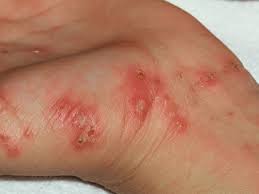
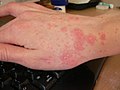
The most common symptoms of scabies, itching and a skin rash, are caused by sensitization (a type of “allergic” reaction) to the proteins and feces of the parasite. Severe itching (pruritus), especially at night, is the earliest and most common symptom of scabies. A pimple-like (papular) itchy (pruritic) “scabies rash” is also common. Itching and rash may affect much of the body or be limited to common sites such as:
  • between the fingers,
  • wrist,
  • elbow,
  • armpit,
  • penis,
  • nipple,
  • waist,
  • buttocks,
  • shoulder blades.
The head, face, neck, palms, and soles often are involved in infants and very young children, but usually not adults and older children.
Tiny burrows sometimes are seen on the skin; these are caused by the female scabies mite tunneling just beneath the surface of the skin. These burrows appear as tiny raised and crooked (serpiginous) grayish-white or skin-colored lines on the skin surface. Because mites are often few in number (only 10-15 mites per person), these burrows may be difficult to find. They are found most often in the webbing between the fingers, in the skin folds on the wrist, elbow, or knee, and on the penis, breast, or shoulder blades.

Medications

  • Sulphur has been used since around 25 AD to treat Scabies. You can find bar soap with sulfur in the ranges of 1%-10% to kill scabies, it's recommended you go with 6% or above. Wash whole body once daily for 4 days. It is still recommended that you wash all clothing and bedclothes in hot water and tumble dry on hot as with Permethrin. However, this treatment is largely ineffective.

Topical drugs

  • Permethrin 5% is topical medication of choice. Toxicity may resemble allergic reactions. It is usually applied to the skin before bedtime and left on for about 8 to 14 hours, then showered off in the morning. Package directions or doctor's instructions should be followed, but one application is normally sufficient to cure an infection
  • Eurax (USP Crotamiton) This is not a cure but helps to relieve itch (pruritis)
  • Malathion: Applied for 24 hours; effective in killing both adults and eggs.
  • Lindane lotion is approved in the U.S. for use as a second-line treatment where first-line medications like permethrin have either failed, are not well tolerated or otherwise contraindicated It is illegal in 17 other countries, and 33 more countries have restricted its use. Though rare, serious side effects have resulted from product misuse.The FDA has confirmed 3 deaths that all involved use of lindane not in accordance with the label, including excessive topical applications and oral ingestions.
  • There is some evidence that a 10% sulfur ointment in petroleum jelly applied topically is effective. It is cheap and readily available over-the-counter. It also has the advantage of being able to be used in pregnant women and infants under two months of age.
  • Neem oil is deemed very effective in the treatment of scabies although only preliminary scientific proof exists which still has to be corroborated, and is recommended for those who are sensitive to permethrin, a known insecticide which might be an irritant. Also, the scabies mite has yet to become resistant to neem, so in persistent cases neem has been shown to be very effective.
  • vitro situation.

Oral

A single dose of Ivermectin has been reported to reduce the load of scabies but another dose is required after 2 weeks for full eradication. In 1999, a small scale test comparing topically applied Lindane to orally administered Ivermectin found no statistically significant differences between the two treatments. As Ivermectin is easily administered (not requiring a rub down of the whole body like lindane or permethrin twice per treatment), compliance is much better. Ivermectin is used in eradication programs of many parasites of both human and animal. Side effects may include mild abdominal pain, nausea, vomiting, myalgia and/or arthralgia, which subside. The product is considered safe for use in children over five months of age.

Public health and prevention strategies

There is no vaccine available for scabies, nor are there any proven causative risk factors. Therefore, most strategies focus on preventing re-infection. All family and close contacts should be treated at the same time, even if asymptomatic. Cleaning of environment should occur simultaneously, as there is a risk of reinfection. Therefore it is recommended to wash and hot iron all material (such as clothes, bedding, and towels) that has been in contact with scabies infestation.
Cleaning the environment should include:
  • Treatment of furniture and bedding.
  • Vacuuming floors, carpets, and rugs.
  • Disinfecting floor and bathroom surfaces by mopping.
  • Cleaning the shower/bath tub after each use.
  • Daily washing of recently worn clothes, towels and bedding in hot water, drying in a hot dryer and steam ironing.

Itchiness during treatment

Options to combat itchiness include antihistamines such aschlorpheniramine. Prescription: Hydroxyzine (Atarax).

Tuesday, September 28, 2010

Hair Loss Causes, Types & Its Management


Hair Loss Causes, Types & Its Management


The human Scalp contains about 100,000 hairs. Due to enormous social implications of hairs, a tremendous amount of time, energy and money is expended on it in care and grooming. But despite this, many women and men are simply plagued with problems. This article is concern with hair loss, hair loss types, causes, important aspects, its management and treatment.
The two major types of hair loss are diffuse hair loss and alopecia areata. Alopecia androgenetica (male pattern baldness, sometimes known as common baldness because it can affect women) is the most common cause of diffuse hair loss. Other causes of diffuse hair loss include telogen effluvium, hypothyroidism, severe iron deficiency and protein deficiency. Occasionally, diffuse hair loss is seen after pregnancy, in chronic renal failure and with certain drugs and chemical agents.
Alopecia androgenetica may be treatable, but there are currently no treatments that the pharmacy can offer for alopecia areata. Although hair loss has been regarded largely as a cosmetic problem, the psychological effects on sufferers can be substantial. A sympathetic approach is therefore essential.
What you need to know
  • Male or female
  • History and duration of hair loss
  • Location and size of affected areas
  • Other symptoms
  • Influencing factors
  • Medication
Significance of Questions And Answers
Male or female
Men and women may both suffer from alopecia androgenetica or alopecia areata. Alopecia areata can affect people at any age.
History and duration of hair loss
Alopecia androgenetica is characterized by gradual onset. In men the pattern of loss is recession of the hairline at the front and/or loss of hair on the top of the scalp. In women the hair loss is generalized and there is an increase in the parting width. Another pattern of hair loss in women in the 20-plus age group is increased shedding of hair but without any increase in the parting width. This latter pattern is not due to alopecia androgenetica and it is thought that the cause may be nutritional. Hair loss in women is increasingly recognized as a problem. Alopecia areata may be sudden and result in patchy hair loss. The cause of alopecia areata remains unknown but it is thought that the problem may be autoimmune in origin. Telogen effluvium usually occurs 2–3 months after significant physical or emotional stress. The rate of hair loss increases significantly for a period of time before resolving spontaneously and returning to normal. Typically this can occur following major surgery or illness.
Location and size of affected area
If the affected area is less than 10 cm in diameter in alopecia androgenetica, then treatment may be worth trying.
Other symptoms
Coarsening of the hair and hair loss can occur as a result of hypothyroidism (myxoedema) where other symptoms might include a feeling of tiredness or being run down, a deepening of the voice, and weight gain. Inflammatory conditions of the scalp such as ringworm infection (tinea capitis) can cause hair loss. Other symptoms would be itching and redness of the scalp with an advancing reddened edge of the infected area. Referral would be needed in such cases. In women excessive bleeding during periods (menorrhagia) could lead to iron deficiency and anaemia, which in turn could cause diffuse hair loss or aggravate alopecia androgenetica. Absent or very infrequent periods are sometimes due to polycystic ovary disease or elevated prolactin levels which in both cases can result in alopecia androgenetica.
Influencing factors
Hormonal changes during and after pregnancy mean that hair loss is common both during pregnancy and after the baby is born. While this is often distressing for the woman concerned, it is completely normal and she can be reassured that the hair will grow back. Treatment is not appropriate.
Medication
Cytotoxic drugs are well known for causing hair loss. Anticoagulants (coumarins), lipid-lowering agents (clofibrate) and vitamin A (in overdose) have also been associated with hair loss. Such cases should be referred to the doctor. Other medications include allopurinol, beta-blockers, bromocriptine, carbamazepine, colchicine, lithium, sodium valproate.
When to refer
  • Alopecia areata
  • Suspected drug-induced hair loss
  • Suspected hypothyroidism
  • Menstrual disorders
  • Suspected anaemia
  • Treatment timescale
  • Treatment with minoxidil may take up to 4 months to show full effect.
Management
Minoxidil
The only treatment licensed for use in hair loss is minoxidil, available as a 2% or 5% lotion with the drug dissolved in an aqueous alcohol solution. Propylene glycol is included to enhance absorption. The mechanism of action of minoxidil in baldness is unknown. The earlier minoxidil is used in balding, the more likely it is to be successful. Treatment is most likely to work where the bald area is less than 10 cm in diameter, where there is still some hair present and where the person has been losing hair for less than 10 years. The manufacturers of minoxidil say that the product works best in men with hair loss or thinning at the top of the scalp and in women in a generalized thinning over the whole scalp – both manifestations of alopecia androgenetica. Up to one in three users in such circumstances report hair regrowth of non-vellus (normal) hair and stabilization of hair loss. A further one in three is likely to report some growth of vellus (fine, downy) hair. The final third will not see any improvement. It is important that patients understand the factors that make successful treatment more or less likely and believe that their expectations are realistic. Some patients may still want to try the treatment, even where the chances of improvement are small. After 4–6 weeks, the patient can expect to see a reduction in hair loss. It will take 4 months for any hair regrowth to be seen, and some dermatologists suggest continuing use for 1 year before abandoning treatment. Initially the new hair will be soft and downy but it should gradually thicken to become like normal hair in texture and appearance.
Application
The lotion should be applied twice daily to the dry scalp and lightly massaged into the affected area. The hair should be clean and dry and the lotion should be left to dry naturally. The hair should not be washed for at least 1 h after using the lotion.
Caution
Irritant and allergic reactions to the alcohol/propylene glycol vehicle sometimes occur. A small amount (approximately 1.5%) of the drug is absorbed systemically and there is the theoretical possibility of a hypotensive effect, but this appears to be unlikely in practice. Minoxidil is also known to cause a reflex increase in heart rate. While this is a theoretical risk where such small amounts of the drug are involved, tachycardia and palpitations have occasionally been reported. The manufacturers advise against use in anyone with hypertension, angina or heart disease without first checking with the patient’s doctor. Although no specific problems have been reported, the manufacturers advise against use when pregnant or breastfeeding. It is important to explain to patients that they will need to make a long-term commitment to the treatment should it be successful. Treatment must be continued indefinitely; new hair growth will fall out 2–3 months after treatment is stopped. 1 year’s treatment costs About £350.
Minoxidil should not be used in alopecia areata or in hair loss related to pregnancy.
Source:
Symptoms in the Pharmacy,A Guide to the Management
of Common Illness 5th Edition.

Family Medical Care by John F. knight
Harrison’s Principle of internal Medicine

Saturday, September 25, 2010

7 Tips To get Rid Of Pimples

7 Tips To get Rid Of Pimples

Here's a nightmare situation for you. You have a huge social event and when you go to bed the night before all is fine and you are filled with anticipation for the big event. When you wake up the next morning there it is, the thing you dread, a huge red pimple right in the middle of your face or forehead!
The good news is that you can get rid of that pimple safely and quickly and be ready for that special event. Just follow these seven simple tips to get rid of a pimple:
1. Apply an icepack to the pimple every 30-45 minutes to decrease the swelling and redness. Hold the icepack in place for 2-3 minutes each time and keep doing this until you are ready to leave for your event.
2. Use a benzoyl peroxide cream or lotion on the pimple and the area around it. This ingredient is a proven zit killer, but it does have a tendency to dry out the skin excessively. I wouldn't necessarily recommend it for everyday use because of this, but occasional emergency use should be fine. There are many over the counter treatments that use benzoyl peroxide as their active ingredient.
3. Resist the urge to poke, squeeze, pick or touch the pimple in any way. There are loads of oils and bacteria on your fingers and adding them to what already in the pimple is not going to help. Additionally, if you squeeze the pimple you are likely to push the liquids and bacteria farther into the pore creating a worse infection, more swelling and increased redness. Even if you do squeeze everything out, this is a surefire way to end up with acne scars.
4. If you notice the pimple coming out the night before your event you can sometimes prevent it from becoming worse by applying a dab of toothpaste to the pimple before bed. This will help reduce the redness and swelling. Other things that can help reduce redness and swelling of the pimple include lemon juice or a wet tea bag.
5. If all else fails you can apply an anti biotic concealer to the pimple before heading out to your special event. Just make sure not to use an oil based concealer which will further clog your pores and make the pimple even worse later.
6. Along those same lines, you should try to wear only make up that is not oil based. Not only do they clog the pores because they have a tendency to stick inside the pore, but they also require you to use harsh cleansers to remove them which can overly dry your skin and lead to more breakouts and pimples. Of course the best prevention is to wear no make up at all.
7. Finally, wash your skin several times daily to remove dirt and oil. Use only gentle cleansers to avoid drying out the skin excessively or use a specialized acne cleanser recommended by your dermatologist. Try not to scrub the skin because you don't want to strip away all the natural oils on your skin.
These 7 tips will yield fast results. Many of you will see a difference in just a day or two. If you continue to have problems with pimples even after using all these methods it might be time to see a dermatologist to get a specialized cleansing treatment or medication made to combat acne. You can also try such simple things as increasing your water consumption and removing oily foods and sweets from your diet. These two changes can often have a dramatic effect on a persons' problem with pimples.

Friday, September 24, 2010

5 Natural Cures for Acne - Safe for Sensitive Skin

5 Natural Cures for Acne - Safe for Sensitive Skin


For people with sensitive skin, choosing the right natural cures for acne might be tricky at first. This is because various ingredients might incompatible with most of acne sufferers' skin, which is usually very sensitive in nature.
There are various natural cures for acne that are safe to be used on sensitive skin. Some of these ingredients contain natural anti-septic, anti-swelling, anti-inflammatory, and strong feature to eliminate toxins or free radicals. You can use one of them at a time to reduce the appearance of your acne.
Honey and Rosewater
The most popular and safe natural ingredient to cure acne is the mixing of honey and rosewater. This combination is refreshing and strongly fights acne. Honey is a trusted natural anti-inflammatory and anti-swelling ingredient that will effectively reduce swelling and inflammation on your skin. Rosewater is known for its refreshing and rejuvenating quality. You can feel refreshed and rejuvenated shortly after applying this mixture.
Cucumber Diet
Cucumber is effective to eliminate free radicals inside your body. It is a useful and strong natural anti-oxidant. Applying cucumber diet for a few days will make your skin healthier and smoother. Just eat more cucumbers every day, including cucumber juice, and you will see the result within a week. Your skin will get smoother, healthier, clearer, and you will see the pimples are slowly fading away.
Strawberry
Strawberry is often ignored by acne sufferers. Aside from its sweet and tasty taste, strawberry contains a lot of salicylic acid, which is useful to promote healthy skin and reduce acne symptoms. You can take the benefits of strawberry by consuming this fruit daily. Don't forget to make a glass of strawberry juice every day to reduce your acne.
Tea Tree Oil Soap
If you can find tea tree oil soap which is completely natural and safe for sensitive skin, you can use this soap as a natural face cleanser. This soap can help to refresh and moisture your skin. This soap can be used every day in the morning and evening. It can also be used for body cleanser, in case you have acne in the body. You should make sure that the soap is natural and not a mixture of certain chemical components.
Aloe Vera
Aloe vera has been used for centuries to eliminate various skin problems. Aloe vera has good quality in fixing the skin structure and rejuvenate it naturally. Applying aloe vera should be done before taking a bath. Rub the aloe vera gel all over your face and wait for 10 minutes. Then, you should immediately take a bath.
Well, those are 5 natural acne cures that are safe for sensitive skin. You can apply the above natural acne cures as you feel appropriate.

Saturday, September 18, 2010

Scleroderma

Scleroderma


1- A disease 
depends on :a- Vascular lesions >> endoth. damage >> .. >> obliterative arterial lesions >> ischaemia ...b-Fibrotic lesions >>and internal organs .. ??
c- Autoimmune mechanism >> may precipitate the vascular lesions or activate the fibrotic mechanism , beside its own harming effect

2-C/P
Skin ; edematous >> fibrotic >> atrophic )
  • Non pitting edema >> and then become tight
  • Skin tightness >> shiny , atrophy , ulceration
  • "Fish mouth " and wrinkles
  • " Salt and pepper " areas of hyperpigmentation and hypopigmentation
  • Raynaud's phenomenon ( pallor>cyanosis>erythema) 2/3 .. What are the precipitating factors of raynaud's phenomenon ??
  • Vasculitis infarction
  • Atrophy and resorption
-MSK ^ Non erosive ^
  • Sclerodermaomyositis ( sclerosis + DM )

- GIT
  • Dysphagia ( lower dysphagia )
  • Reflux " due to laxity of the lower eso. sphincter " >> aspiration pneumonia and hoarseness
  • Malabsorption $ " due to over bacterial growth "
  • Intestinal pseudo-obstruction..... so , the patient presents with a long duration of constipation followed by a sever diarrhea .. so doctors prefer to give a prophylactic course of antibiotic every month ..

-IPF >>
  • Pulmonary HTN ..

- Myocardial fibrosis >>
  • Conduction and contraction defects

- ENT
  • Sicca-like $
  • Hoarseness of voice due to acid reflux

-Genetalia ( due to fibrosis )
  • Erectile dysfunction in males
  • Dysparonia in females

- Hypothyrodism ( due to fibrosis of the secretory acini )

- Scleroderma kidney ( also due to fibrosis )
  • Malignant HTN
  • Renal failure
  • Scleroderma renal crisis^abrupt onset


3- Investigations
- To detect the different affection ... ??
- Anti-Scl 70 ... Specific , but only in 20-30 %
- ANA +ve in 90% & Rh.f +ve in 30 % "sero +ve"

4- Treatment

- No specific satisfactory drug therapy
- symptomatic and life style modification ... ??
- Vasodilators
  • ACEI from the start .. to prevent the Renal crisis .. and never stop if only produce cough >> shift to ARBs
  • Viagra in winter , .. to females ??!!
  • SSRI >> vasodilator + decrease TGF-Beta
  • Iloprost " prostacyclin analogues substance "
-Mycophenolate : prevents internal organ fibrosis
-high dose CS " > 30 ".. is contra-indicaed as it can precipitate renal crisis ...

Images Of HERPES ZOSTER

Herpes Zoster In Different Presentations


Erythema marginatum

Erythema marginatum 

Is described as the presence of pink rings on the trunk and inner surfaces of the arms and legs which come and go for as long as several months.

Causes 
  1. Infections
  2. Bacteria: Escherichia coli , streptococcal infections 
  3. Fungi: Dermatophytes , Candida albicans and blue cheese Penicillium. 
  4. Mycobacteria: Mycobacterium tuberculosis. 
  5. Parasites: Ascaris lumbricoides 
  6. Viruses: (EBV) & was reported in an HIV-positive patient.
  7. Drugs: In the cases of the antimalarials chloroquine and hydroxychloroquine, the eruptions took 5 months to a year to clear, and there are another many drugs .. 
  8. Neoplasms: Hodgkin disease, acute myelogenous leukemia (AML), and squamous cell carcinoma in a sebaceous cyst , and others …
  9. Foods: Blue cheese and tomatoes have been reported to cause EAC. 
  10. Other causes 
  • Cholestatic liver disease
  • Graves disease 
  • Hypereosinophilic syndrome 
  • Sjögren syndrome 
  • Sarcoidosis 
  • Osteoarthritis 
  • Stress 
  • Pregnancy

MANAGEMENT

Erythema annulare centrifugum (EAC) is usually self-limited. Topical steroids usually cause involution of the treated lesions, but they do not prevent the occurrence of new lesions or recurrence of the eruption.